March 2014

Book: Guide to OSI and TCP/IP Models

  • Provides a simplified introduction to computer networks
  • Requires no prior background in the field
  • Discusses the fundamentals of the network, transport and application layers
This work opens with an accessible introduction to computer networks, providing general definitions of commonly used terms in networking. This is followed by a detailed description of the OSI model, including the concepts of connection-oriented and connectionless communications. The text carefully elaborates the specific functions of each layer, along with what is expected of protocols operating at each layer. Next, the journey of a single packet, from source to destination, is described in detail. The final chapter is devoted to the TCP/IP model, beginning with a discussion of IP protocols and the supporting ARP, RARP, and InARP protocols. The work also discusses the TCP and UDP protocols operating at the transport layer, and the application layer protocols HTTP, DNS, FTP, TFTP, SMTP, POP3, and Telnet. Important facts and definitions are highlighted in gray boxes found throughout the text.
Published: March, 2014 by Springer.
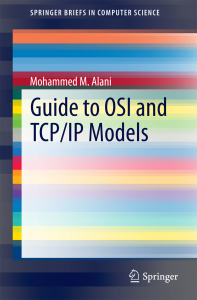
Guide to OSI and TCP/IP Model

Guide to OSI and TCP/IP Model

Develop research culture in the Arab Middle East

I wrote a letter to the Editor of the Communications of the ACM that was published in Issue 3/Vol 57 (March, 2014).

It was only 2002 when I first knew ACM even existed. I was preparing my master’s thesis in computer engineering in Iraq. I was so amazed I thought of ACM members as movie stars. Due to many circumstances, I did not have the honor of joining as a member until 2010. Having received my bachelor’s, master’s, and Ph.D. in the Middle East, I have always seen a gap, a large one, between the way research is conducted there on one side and in Europe and the U.S. on the other. This feeling has been enforced whenever I get a rejection letter for a paper sent to a big computer science conference or journal. Sometimes, unfortunately, reviewers have mocked and even ridiculed instead of provided a constructive review. This happened in the early stages of my own research, and, as I learned later, to many of my colleagues as well. In most cases, when I look at Arab scientists who have published in reputable conferences and journals, I see author names of those who have either studied abroad or are working abroad, many very successful with outstanding research records. What does this say?

The Arab Middle East needs a cultural revolution in terms of research, especially in computer science. The research mentality here is quite different from other areas of the world. This is not to say it is not scientifically valid, just that research here is conducted in a different way that needs to be formalized to conform to international standards. Many researchers in the Arab world have amazing potential. Unfortunately, that potential is not being unleashed until they go abroad.

I sincerely hope ACM takes the initiative in helping spread a valid and concrete academic research culture in the Arab world. We all aim for the same thing—improving the quality of life for ourselves and for the coming generations. The lack of tools and research culture should not prevent Arab computer scientists from contributing to the development of all humanity.

The letter can be found in here.

All feedback is welcomed.